Trump and Ramaphosa Clash Over South Africa’s ‘White Genocide’ Claims
Trump and Ramaphosa Clash Over South Africa’s ‘White Genocide’ Claims
A tense confrontation unfolded in the Oval Office on May 21, 2025, when former U.S. President Donald Trump met with South African President Cyril Ramaphosa. What was supposed to be a routine bilateral meeting on trade quickly turned into a charged exchange over Trump’s explosive allegations that white South African farmers were victims of “genocide” and violent land seizures. Trump has long claimed that South Africa’s white minority, particularly Afrikaner farmers, are subject to brutal attacks and discriminatory policies – a narrative widely dismissed by experts as a baseless conspiracy theory. Ramaphosa, who came to Washington hoping to mend frayed ties, was instead forced to defend his country’s record and refute the false claims of “white genocide” during an extraordinary on-camera encounter.
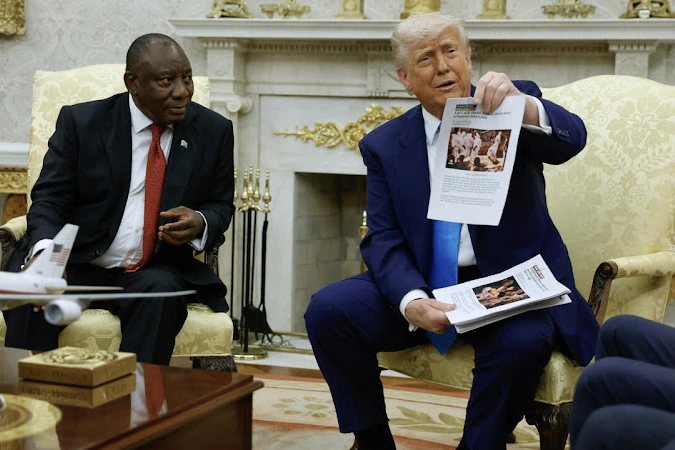
President Donald Trump shows South African President Cyril Ramaphosa a stack of news articles in the Oval Office on May 21, 2025, as he claims white farmers in South Africa are being persecuted and killed.
Trump did not mince words in the meeting. With TV cameras rolling, he pressed Ramaphosa to protect white Afrikaner farmers from what he described as widespread, racially motivated violence. In a carefully orchestrated presentation, Trump even asked staff to dim the Oval Office lights so he could play a video purportedly showing evidence of attacks on white farmers. The video – projected on a screen brought in for the occasion – showed rows of white crosses and clips of fiery speeches by South African political figures. As images of crosses appeared, Trump asserted, “These are burial sites…over a thousand of them…all white farmers…those people are all killed,” implying a mass killing campaign. He also displayed printed news stories while intoning “death, death, death” to dramatize his point.
Ramaphosa’s Response and Denial
Sitting beside Trump, President Ramaphosa maintained a calm demeanor and repeatedly pushed back against the allegations. He clarified that South Africa does struggle with violent crime – but emphasized that “people who do get killed…are not only white people. The majority of them are Black people”. Indeed, South Africa endures one of the world’s highest murder rates, with an overwhelming majority of victims being Black South Africans. Ramaphosa firmly rejected the notion of any official campaign against white farmers, telling Trump, “There is just no genocide in South Africa”. At one point, he noted that if Afrikaner farmers were truly being systematically exterminated, prominent white South Africans would hardly be traveling with him: “If there was Afrikaner farmer genocide, I can bet you these three gentlemen would not be here,” Ramaphosa said, gesturing to the white South African golfers (Ernie Els and Retief Goosen) and billionaire Johann Rupert who accompanied him. This gentle rebuke highlighted the absurdity of claims that whites are unsafe in South Africa, although Trump appeared unconvinced.
Ramaphosa also sought to put the provocative video footage in context. As chants of “Kill the Boer, kill the farmer” rang out in Trump’s video – a slogan from an old anti-apartheid song – Ramaphosa explained that those clips showed opposition figures, not government policy. He noted South Africa’s democracy allows people to express themselves (even in controversial ways) and that his ruling party does not endorse such rhetoric. South Africa’s Agriculture Minister John Steenhuisen, a white politician in Ramaphosa’s multiparty coalition, spoke up to reinforce the point. He told Trump that the two men shouting in the video (one of them Julius Malema, leader of the far-left Economic Freedom Fighters) were opposition leaders – and that moderates like himself had “joined forces with Ramaphosa to keep those people out of power.” In other words, the very presence of Steenhuisen in Ramaphosa’s team underscored that the South African government is inclusive of whites and actively working against extremists who use inflammatory slogans. Throughout the meeting, Ramaphosa remained poised and factual despite Trump’s interruptions and the uncomfortable setting. Observers at home praised the South African president for keeping his cool and sticking to the facts under pressure.
The ‘White Genocide’ Myth Versus Facts
Trump’s alarming narrative of a “white genocide” in South Africa is not supported by evidence, according to independent fact-checks and crime data. While it is true that some white farmers have been victims of violent crime, analysts agree these are part of South Africa’s broader crime problem – not a targeted campaign. In 2024, for example, South African police recorded 26,232 murders nationwide, of which only 44 were incidents linked to farming communities, and just 8 of the victims were farmers. That is a tiny fraction of overall homicides. Data collected by a major Afrikaner farmers’ union similarly shows about 40 white farmers murdered per year, which is less than 1% of total annual murders in the country. Most murder victims in South Africa are Black, and urban crime and armed robberies account for far more deaths than rural farm attacks. There is no statistical indication of an organized racial extermination campaign.
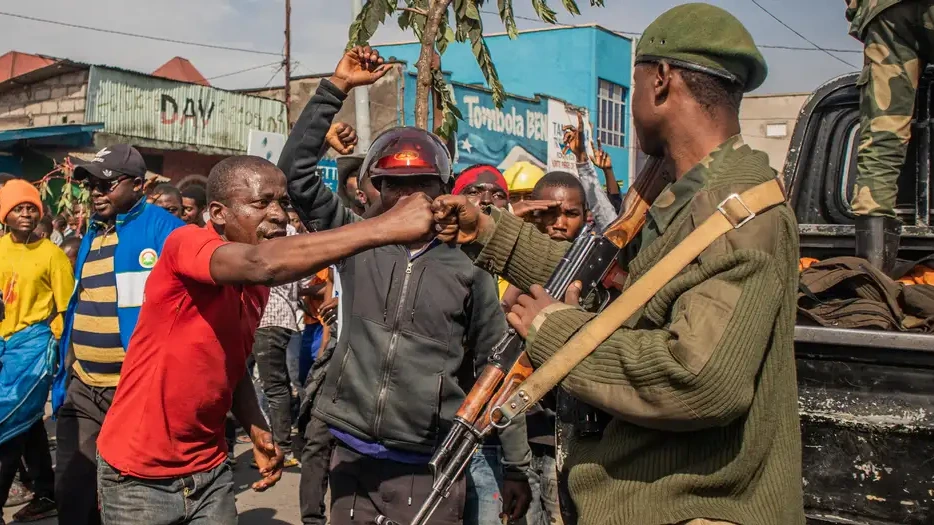
Multiple independent fact-checkers debunked the specific “evidence” Trump presented in the Oval Office. The dramatic video of white crosses that Trump described as “burial sites” for murdered farmers was taken wildly out of context. In reality, those crosses were part of a protest memorial temporarily erected in September 2020 after a white farming couple, Glenn and Vida Rafferty, were killed by robbers on their farm. Local organizers and even the Raffertys’ son confirmed the crosses were not actual graves, but symbols commemorating all farmers (Black and white) killed over the years, and they were removed after the protest. Another image Trump showed – depicting bodies in bags being lifted for burial – had nothing to do with South Africa at all: it was a Reuters photograph from Goma, Democratic Republic of Congo, showing victims of fighting in that region. Trump’s team apparently found that image on a blog about African “tribalism” and misrepresented it as proof of farmers being massacred. These false or misleading visuals, far from proving any “genocide,” underscore how the narrative has been fueled by disinformation.
International monitors also point out that no government plot to kill white farmers exists. A South African High Court explicitly ruled earlier in 2025 that claims of “white genocide” are “clearly imagined and not real.” In that case, the court even blocked a bequest in a will to a white-supremacist group preparing for an imaginary race war, noting there was zero evidence of any genocide against whites. Police Minister Senzo Mchunu has openly condemned Trump’s statements, saying it was “unfortunate that those facts got twisted to fit a false narrative” of genocide. He revealed that in the first three months of 2025, out of more than 5,700 murders in South Africa, only 6 occurred on farms – and just 1 victim was white. “We have respect for the president of the United States,” Mchunu said diplomatically, “but we have no respect for his genocide story whatsoever.”
Far from being a deliberate campaign, farm attacks (when they occur) are generally seen as robberies targeting remote homes for cash, weapons, or vehicles – not racially motivated hate crimes. Both Black and white farmers have been victims of these crimes, and the South African government has repeatedly denounced violence against all farmers. Even one of the right-wing Afrikaner lobby groups that raises awareness about farm security has stated it does notbelieve the government is behind the violence. In short, the consensus of law enforcement, courts, and independent analysts is that the “white genocide” allegation is a false, extremist narrative. It originated in fringe circles and has been amplified by far-right activists and some media personalities for years, but it does not reflect reality.
Land Reform Debate: Context Behind the Claims
To understand the friction, it helps to know the background of South Africa’s land reform debate. The country’s brutal history of colonialism and apartheid created severe racial disparities in land ownership. Under apartheid, non-white South Africans were largely prohibited from owning land in most areas. By the time apartheid ended in 1994, the vast majority of farmland was in white hands, even though whites are a small minority of the population. A government land audit in 2017 found that about 72–75% of individually owned farmland was held by white owners, who make up only 7–8% of the population. This inequity is an enduring legacy of institutionalized discrimination.
Successive post-apartheid governments (including Ramaphosa’s) have grappled with how to redress the land imbalance. The South African Constitution allows for land reform, and in early 2025 Ramaphosa signed a new Expropriation Act empowering the state, in rare cases, to expropriate land “in the public interest” without compensation. Officials stress that this is intended as a last-resort tool to speed up land redistribution for justice and economic development. No land has actually been seized outright under the law to date, and any expropriation order can be challenged in court. In practice, the government has preferred to buy land from willing sellers or settle restitution claims rather than confiscate property. Still, the mere idea of possible uncompensated expropriation has alarmed some white farmers and become a flashpoint for misinformation.
Trump seized on South Africa’s land reform plans as evidence of anti-white bias. He claimed (inaccurately) that the government was already “taking land” and letting farmers be killed with impunity. In reality, South Africa’s leaders describe the expropriation law as a carefully crafted measure to fix historical injustices, not a wholesale land grab. Ramaphosa has repeatedly defended the policy as lawful and fair. He wrote that the law “is not a confiscation instrument, but a constitutionally mandated legal process” to ensure equitable access to land in line with the constitution. Independent observers agree that labeling this effort “genocide” or an attack on whites is completely wrong. As one scholar noted, the land reform is about addressing a “gross wealth imbalance” left by apartheid – calling it a genocide is “completely erroneous in terms of fact.”
It is worth noting that the opposition politician most featured in Trump’s video, Julius Malema, has indeed used militant rhetoric about land (“we will occupy the land” and songs like “Kill the Boer”). Malema’s Economic Freedom Fighters party advocates drastic redistribution of land and has unnerved many farmers. However, Malema is not part of the government – he’s an outsider firebrand, and his party won only about 10% of the vote in the last election. South African courts have even weighed in on the contentious “Kill the Boer” chant: three different courts ruled it is not to be taken literally as hate speech or an instruction to murder, but rather a “historical liberation chant” from the apartheid struggle era. (The song originally voiced defiance against an oppressive regime, though its continued use today is debated.) Following the Oval Office incident, Malema’s EFF pointed out that the song expresses a desire to end white minority domination of resources, not to slaughter whites. “We didn’t know we would form part of those theatrics,” an EFF spokesperson dryly remarked, criticizing Trump’s video ambush and flatly stating that a supposed white genocide “is obviously not occurring in South Africa.”
Crime and Farm Attacks in Perspective
Crime is a serious problem in South Africa across all communities. The country struggles with high rates of murder, armed robbery, and violent assaults, a legacy of social inequality and other challenges. Rural areas, including farms, are not immune to this general crime wave. Farmers (both Black and white) have sometimes been targeted by criminals because farms can be isolated and far from immediate police help, and may contain cash, guns, or vehicles. Some of the attacks on farm families have been notoriously brutal, which has understandably created fear. But experts caution that these farm attacks comprise only a small portion of overall violent crime, and there is no evidence of racial targeting in a majority of cases. South Africa does not even compile crime statistics by the race of the victim, so any claim that only whites are being killed is impossible to support with data.
In fact, government data suggest Black rural residents face equal or greater vulnerability to violence in farming areas. The notion that perpetrators get off scot-free when victims are white is also false – South African authorities prosecute farm murder cases just as they do others, and have publicly condemned attacks regardless of the victim’s race. During the Oval Office meeting, even Johann Rupert, the white South African billionaire in Ramaphosa’s delegation, chimed in to tell Trump that crime “is a problem across the board and many Black people are dying too.” Rupert’s intervention reinforced that violence in South Africa is not one-sided. South African officials acknowledge there is a “rural safety problem” – meaning farmers and farm workers deserve better protection – but they insist it is a criminal issue, not a racial vendetta. Ramaphosa told Trump his government is willing to discuss these safety concerns and work on solutions for all communities.
For additional perspective, consider that white South Africans today still tend to be far more affluent and securethan the average Black South African. More than 30 years after apartheid, whites (about 7% of the population) continue to own a disproportionate share of land and wealth. Many live in well-resourced areas or gated estates with private security. This doesn’t negate the trauma of any farmer who is attacked or killed – every murder is a tragedy – but it does show why the claim of “white genocide” strikes most South Africans as deeply absurd. As columnist Barney Mthombothi put it, “The whole idea that White South Africans are being oppressed is so scandalous, it’s offensive to Black people who have been oppressed for centuries.” In other words, portraying the historically privileged group as the victims of systematic persecution not only lacks factual basis, it flips reality on its head in a way many find insulting.
South African Reactions: Praise, Dismay, and Satire
The Oval Office showdown became headline news in South Africa, provoking a range of reactions from political leaders, civil society, and the public. Many South Africans applauded Ramaphosa’s composure in the face of what they saw as a provocational “ambush.” “President Ramaphosa did well to maintain a calm demeanor and stick to the facts as close as possible,” noted Pieter du Toit, a prominent political journalist. A local analyst, Mpumelelo Mkhabela, likewise observed that Ramaphosa wisely chose not to engage in a shouting match but “played the role of a defender” to avoid escalating the confrontation. Given Trump’s combative stance, Ramaphosa’s measured response earned him credit at home for upholding South Africa’s dignity.
However, others questioned why Ramaphosa agreed to the meeting under such conditions at all. “I don’t think it was the right call. I don’t think we need to explain ourselves to the USA,” said Sobelo Motha, a trade union member interviewed in Johannesburg, adding that South Africans already know there’s “no white genocide” and thus “for me, it was a pointless exercise.” This view reflects a sense of pride (and frustration) among some that the president shouldn’t have to debunk conspiracy theories to foreign leaders. Critics argued that Ramaphosa walked into a trap, since it was widely suspected Trump would raise these issues. Indeed, even before the visit, some analysts warned the encounter might be a “setup” designed more to play to Trump’s domestic base than to find common ground.
Social media in South Africa lit up with commentary, much of it mocking the spectacle. One widely shared video snippet showed Ramaphosa struggling to suppress a grin when Trump’s dimmed-light presentation featured Julius Malema singing the “Kill the Boer” song. Many found humor in the awkwardness. “Cyril can’t even contain his laughter… yhooooooo,” one user posted, using the tongue-in-cheek nickname “cupcake” for Ramaphosa. Others joked about Trump’s offer to take in white South African “refugees,” with one commentator quipping on X (Twitter) about whether applicants would need to pass an “Afrikaner identity” test or if Elon Musk might sponsor them on the other side. The gallows humor underscored how surreal the notion of a mass exodus of white South Africans appeared to most people there.
Importantly, South African political groups across the spectrum rejected Trump’s narrative. Ramaphosa’s ruling African National Congress (ANC) bluntly said Trump was amplifying misinformation propagated by fringe lobbyists. The main opposition parties also denied any “white genocide.” Notably, the far-left EFF – despite its fiery rhetoric – clarified that their dispute is with inequality, not an intent to harm white citizens. On the right, Afrikaner organizations that had raised concerns about farm security still refused to endorse Trump’s refugee offer. The Solidarity Movement, representing several Afrikaner community groups, affirmed, “We may disagree with the ANC, but we love our country… Repatriation of Afrikaners as refugees is not a solution for us.” Even residents of Orania, an Afrikaner-only town, said “Afrikaners do not want to be refugees. We are committed to our homeland.” The CEO of AfriForum, the influential Afrikaner civil rights group, thanked Trump for his concern but politely said “no thanks,” suggesting Afrikaners would rather stay and “tackle the injustices…on home soil” than abandon South Africa. In short, no major South African constituency actually believes there is a government-led race war—apart from a handful of extreme voices that even most white South Africans ignore.
U.S. and International Reactions: Fact-Checks and Fallout
In the United States and globally, Trump’s Oval Office dramatics were met with widespread skepticism and factual rebuttals. Prominent media outlets like Reuters, the BBC, the Washington Post, and The Guardian quickly published fact-checks and analyses debunking the president’s claims point by point. The consensus in reputable news coverage was that Trump was pushing a false, racially charged narrative that has long been circulating in far-right circles online. The Washington Post noted that Trump’s stance fit a theme of his political messaging – portraying white people as victims of supposedly overzealous equity efforts – and that he conspicuously failed to mention South Africa’s actual history of white rule and apartheid during the exchange. Many outlets highlighted that Trump’s claims mirrored talking points promoted by white nationalist groups and even one of his advisers, Elon Musk, who had tweeted similar warnings about South Africa in the past.
Editorials and commentators were often scathing. A Guardian editorial described the Oval Office episode as a “fact-free reality show” staged for Trump’s base, arguing it did more to embarrass the U.S. presidency than to shame Ramaphosa. Analysts at foreign policy think tanks observed that Trump’s focus on this issue was straining Washington’s relationship with Pretoria at a time when cooperation on trade and security might otherwise be pursued. There was also concern that other world leaders might think twice before visiting the Trump White House, given how Ramaphosa (and previously Ukraine’s President Zelensky) had been treated to public browbeating on live television. For Trump’s supporters, however, the confrontation was celebrated as him taking a bold stand against what they perceive as anti-white persecution abroad. Far-right commentators echoed Trump’s assertions, while mainstream fact-checkers simultaneously scrambled to assure the public that no “genocide” was occurring in South Africa.
Within days, diplomatic ripples from the meeting began to emerge. The White House doubled down on Trump’s claims: it released an official statement titled “President Trump is Right About What’s Happening in South Africa,”listing cherry-picked news clippings (including from Fox News and Breitbart) that it said supported his stance. This unprecedented move – essentially accusing a friendly nation of persecuting a minority – forced South Africa’s government into further defensive messaging. South African officials in Washington and Pretoria reiterated that no ethnic cleansing or state-backed land grabs were underway, and they pointed to the rule of law and constitutional protections in their country. Ramaphosa, speaking to reporters after the meeting, diplomatically said the talks went “very well” and that he thought Trump heard him out. But the very next day, Ramaphosa plainly told the media, “There is just no genocide in South Africa,” seeking to put the matter to rest.
On the economic front, South Africa moved to contain any fallout. Ramaphosa had come to Washington largely to discuss trade and avoid potential penalties under Trump’s trade policies. (The U.S. is South Africa’s second-largest trading partner, after China.) During the meeting’s latter half, once the public “ambush” ended, Ramaphosa pivoted to business: he proposed new partnerships on critical minerals and even floated plans for South Africa to purchase American liquefied natural gas. His goal was to preserve the country’s inclusion in the African Growth and Opportunity Act (AGOA), a U.S. program that grants duty-free market access to certain African countries but was set to expire in 2025. South African officials privately worried that Trump might use the genocide allegation as a pretext to impose tariffs or end South Africa’s AGOA benefits, which could hurt an economy already battling slow growth and high unemployment. As a precaution, Ramaphosa’s team leaned into what one observer called “economic diplomacy” – effectively trying to mollify Trump with trade deals and even personal touches (like bringing golf celebrities Trump admired).
Despite the public sparring, no immediate punitive action followed the meeting. There were no new U.S. sanctions or tariffs on South Africa in the immediate aftermath, and diplomatic channels remained open. Still, the relationship clearly suffered turbulence. A few months earlier, Trump’s administration had already expelled South Africa’s ambassador and cut off some foreign aid, citing complaints about the land reform law and South Africa’s stance on international issues. (Trump was angry that South Africa filed a case at the International Court of Justice accusing Israel – a U.S. ally – of genocide in Gaza, seeing it as anti-American behavior.) The Oval Office incident only added to the strains. Some South African commentators suggested their country might pivot more towards other partners (like the EU or China) if the U.S. ties remained rocky. On the other hand, optimists in Ramaphosa’s camp noted that behind closed doors, once the cameras were off, Trump reportedly turned jovial and discussed investment opportunities without the earlier hostility. This hinted that the Oval Office clash might have been, at least in part, theater for Trump’s domestic audience.
A New Chapter After the Storm?
In the weeks since the meeting, both governments have tried to move forward, albeit cautiously. South Africa launched a charm offensive emphasizing shared interests: energy, infrastructure, and public health collaborations with the U.S., downplaying the feud over farmers. U.S. officials, for their part, have been relatively quiet on the topic of South African land reform following the Oval Office drama. There have been no further high-profile accusations from Trump on the matter after May, suggesting the confrontation and its fact-checking blowback may have exhausted the issue for now. Diplomatic engagement has continued at lower levels – trade negotiators met to discuss avoiding the threatened 30% tariffs on South African goods, and progress was reported on a deal for critical minerals. Notably, President Ramaphosa extended an invitation for Trump to visit South Africa for the G20 summit in Johannesburg in November 2025, as South Africa holds the G20 presidency next year. Trump did not commit to attending, but the invitation itself signaled South Africa’s willingness to maintain dialogue.
Publicly, Ramaphosa has tried to frame the episode in a positive light, calling the talks “robust and fruitful” and expressing hope it could “open a new chapter of engagement” between the two countries. Whether that optimism bears out remains to be seen. What is clear is that the so-called “white genocide” claims have been thoroughly debunkedby factual evidence, and South Africa’s government has stood firm in denying any such atrocity. The episode served as a vivid reminder of how easily misinformation can sour international relations, but also how resilience and truth can counter it. As South Africans often say, “we know there’s no white genocide” – and now, thanks to extensive fact-checking and diplomacy, more of the world knows it too.
References
- Reuters – Trump confronts South Africa's Ramaphosa with false claims of white genocide
- Washington Post – Trump pushes false claims of genocide in tense meeting
- The Guardian – Trump’s evidence of ‘white genocide’ contains false images
- Associated Press – S. African officials debunk Trump’s twisted facts on farmer killings
- ABC News – Fact Check: Trump’s claims vs. reality in South Africa
- Reuters (Fact Check) – A check of Trump’s false claims about white genocide
- Reuters – “No thanks”: White South Africans turn down Trump’s refugee offer
- Guardian – Praise and dismay in South Africa over Trump meeting
- Reuters – Under attack by Trump, Ramaphosa focuses on trade deal offer
- Washington Post – ‘White genocide’ in South Africa is not real, court rules