Implications of IQ
The concept of IQ is popular these days. Yet, it seems to be used generally for a frivolous purpose rather than for an earnest discussion, often as a joke or a meme. IQ has been controversial throughout history – from being used for eugenist claims to the recent day’s IQ fundamentalism. Perhaps people don’t take IQ as a serious intellectual or cognitive measure for that reason. However, unlike the popular belief and perceptions on IQ, what modern psychology has revealed seems to signify that intelligence quotient might hold much more significance.
But what exactly does IQ measure?
Before discussing the significance of IQ, it is worth [clarifying] what exactly it indicates. What exactly is it measuring?
The history of attempting to measure intelligence dates back to the 20th century. While studying the relationship between the students’ academic performance on different subjects, English psychologist Charles Spearman in 1904 found that there are correlations between students’ performances on different subjects. For example, there was a 0.64 correlation between performances in English and Math. Moreover, academic achievements in different subjects generally had a correlation of 0.6-0.8, suggesting there is a third variable that commonly influences the students’ performances. Spearman accordingly theorized that there is a single variable of general intelligence, the g factor, that forms the basis of every cognitive ability. Additionally, he said the specific intelligence factor, s factor, explains minor differences between subjects.
Meanwhile, around the same time, the French government actively encouraged providing additional special education for slowly developing kids. Accordingly, Alfred Binet and Theodore Simone developed the tool called the Binet-Simone scale to help identify kids with slow development. The early model measured the cognitive ability and quantified it using average age performance. For example, if a kid’s score was about the average of a 12-year-old, the scale would be the ratio of 12 to the actual age of the kid. This scale was modified by Lewis Turman with the statistics from the American population and modified to the Stanford-Binet test, having more focus on problem-solving ability and abstract thinking to solidify its function as general intelligence test.
On the other hand, the theory of intelligence was sharpened by the psychologists opposing the idea of a single general intelligence factor. Many, including professional psychologists, didn’t believe the theory suggesting that one factor primarily decides a person’s intelligence to be right. Most notably, American psychologist Howard Gardner proposed the theory of multiple intelligences, claiming there are eight independent types of intelligence, and made a wave in academia. However, the model is criticized for its ambiguous definitions of intelligence when classifying its type, not clearly distinguishing the cognitive ability of the brain with talent. For example, among the eight types was Bodily-Kinesthetic ability. In addition, putting interpersonal, intrapersonal, and naturalistic ability into the category of intelligence was not seen as valid, as his definition of intelligence was too broad, again confounding what should be defined as intelligence. Moreover, even among some categorized types of intelligence, it was proven that there were clear correlations between the intelligence types, ultimately collapsing to the g.
Still, with the later studies, it was accepted by the major academy that intelligence can be categorized by different types based on their functions. One of the popular categories, for example, is fluid intelligence – an ability to reason, solve novel problems, and think abstractly without relying on prior knowledge – and crystal intelligence – an ability to accumulate knowledge, facts, and verbal skills through experience and education. Knowing that all different cognitive abilities ultimately collapse into g, John Carroll established the modern intelligence model, putting different abilities into a hierarchy in which the g factor is at the top and the different abilities are placed into the levels of Stratum depending on their specificity.
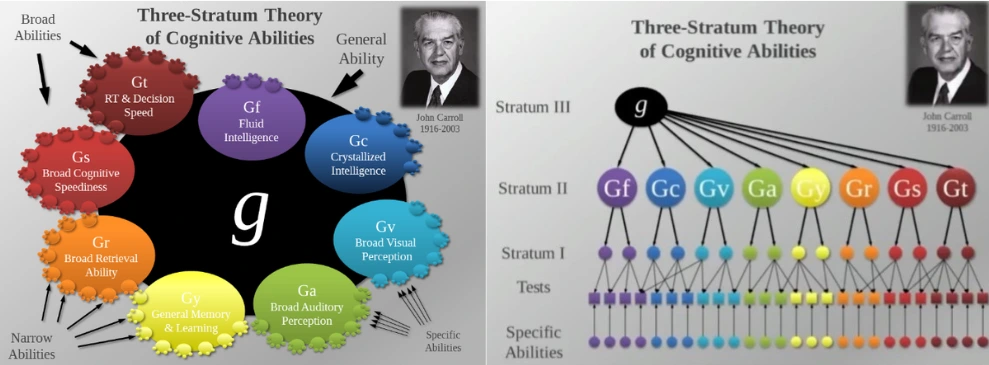
Thus, according to modern psychology, IQ is a measure that illustrates the general range and trend of individuals’ cognitive abilities: It does not dictate every aspect of individuals’ cognitive ability, but it is a variable that constitutes the foundation of cognitive abilities.
Then, there is an important question to be answered: if there is a single measure of general intelligence that co-founds different cognitive abilities, what implication does it hold?
Because of its characteristic as a strong measure of intelligence, IQ has been found to have a high correlation with many cognitively demanding tasks. In 2007, Scottish psychologist Ian Deary, studying 13,000 kids, found that the IQ measured when they were 11-year-olds and the GCSE test (standard academic test of UK) score measured when they were 16-year-olds had a correlation of 0.8. Thus, about 64% of standardized academic scores at age 16 can be predicted by the IQ measured 5 years ago – that is a huge correlation. In addition, numerous studies have consistently reported that IQ has a correlation of 0.5-0.75 with the standardized tests like the SAT and ACT. Because of such a high correlation, some people argue that the standardized academic assessments are fundamentally IQ tests.
It has also been shown that IQ is correlated with job performance. Depending on the complexity and how cognitively demanding it is, performance on some of the jobs with high complexities (upper 17% of U.S. jobs) are reported to have a correlation of 0.57, 0.51 for moderately complex jobs, and 0.38 for low-complexity jobs. Additionally, for the extreme ends, extremely complex jobs have up to 0.71 of correlation, while some of the simplest jobs have a correlation of 0.39. Not surprisingly, highly complex occupations had average IQs around 114-117, while less complex jobs have employees with lower average IQs around 87-89, showing that more complex jobs indeed demand greater cognitive processing and handling of various information.
—
(More facts indicating cognitive ability is one of the best predictors of job performance in its accuracy and objectivity)
—
The implication of this can be significant: if the achievements from a job are highly correlated with IQ, it is very likely for a person with a lower IQ than the job average to have lower occupational achievement, leading to less job satisfaction. Meaning, assuming that if one is choosing a job aiming for satisfiable achievements from it, perhaps about the same or a bit above average, there is a decided range of the complexity of jobs that one can choose. In addition, while factors like conscientiousness also contribute to job performance and people with a lower IQ than the job average can make up their achievements by working longer and harder, it often results in lower satisfaction – unless they are very passionate and enjoying their work. However, because there is a limit in working hard – resources like time and biological limitations – in an environment where everyone is very dedicated, it can be even harder for the lower IQ individuals to achieve more than average.
What’s more, history has empirically shown this relationship between cognitive ability and job performance to be considerably true. Since 1948, the U.S. military has introduced a formal intelligence test in the recruiting process, called the Armed Forces Qualification Test (AFQT), and restricted individuals with low intelligence from enlisting. However, when the Vietnam War broke out, the U.S. military wanted to recruit as many people as possible, and Secretary of Defense Robert McNamara came up with Project 100,000 to ease the cognitive ability restriction and included 350,000 men who previously weren’t qualified for enlistment. The result was unfortunate: They were 1.5-3 times more likely to fail basic recruit training and required 3-9 times more remedial training (Gregory). Moreover, the mortality rate of these soldiers was 3 times higher than that of other soldiers. In total, the military ran more efficiently without extra recruitment, and the Project 100,000 remained a failure. The restriction for recruitment was restored, and today, people with an IQ of less than 85 are ineligible for joining the military.