Why Every Tech Giant Wants a Piece of F1
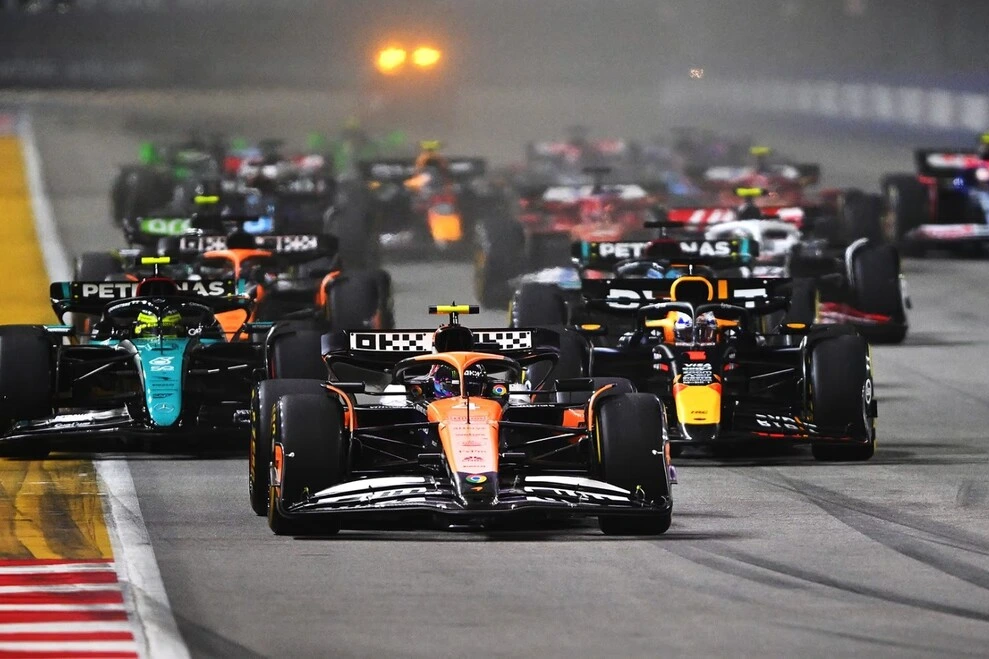
The way we experience modern Formula One (F1) has changed dramatically since the days of "just" racing. Today's F1 cars are no longer simply machines built to speed down a track; they have become a platform for the next level of technology competition based upon data. According to McLaren Racing, each F1 car can generate between 1 and 2 terabytes of data during a typical race weekend through hundreds of sensors that measure a wide variety of information including tire temperature, aerodynamics load, fuel flow, engine efficiency, and the driver's input. Based upon that data, teams now use sophisticated simulation programs, artificial intelligence models, and real-time telemetry data to make tactical decisions almost instantly and adjust their race strategies within milliseconds. Millions of simulations are performed prior to an F1 car taking its first lap around the circuit so that engineers may anticipate and predict the behavior of their car under every conceivable condition such as weather changes, tire wear and tear, and safety car deployment. Therefore, today's F1 cars are essentially a mobile supercomputer on wheels where the difference between winning and losing is less about raw horsepower and/or the skill of the driver than it is about the software and algorithms developed to analyze the vast amounts of data being generated, the ability to process large volumes of data quickly, and to apply predictive analytics to optimize their car's performance.
As a direct result of these advancements, technology companies see F1 as a unique opportunity to test, demonstrate and utilize their various technologies, including data analytics, cloud computing and AI capabilities under extreme conditions.
Technology companies enjoy an unparalleled opportunity to promote themselves through F1 branding opportunities as well as reach a highly desirable target audience. There are nearly 400 million viewers watching the championship worldwide and F1 events are held throughout Europe, the Middle East, Asia, and the Americas allowing companies to be promoted to their target audience at least once per week during the season. Additionally, unlike other major sports, F1's audience is significantly wealthier and better-educated than the average sports fan, which aligns perfectly with the demographics typically sought after by the sponsors of enterprise technology companies. Brands are not only exposed through the placement of their logos on F1 cars and drivers, but through all aspects of the event including paddock systems, garage facilities, broadcast graphics, and even the data analysis shown during live coverage of the event. Technology companies like AWS, Oracle and Google are able to leverage this exposure to show how their cloud platforms, AI-based tools and data solutions are used to support the decision-making process of race strategy, team performance and fan engagement through the display of their products' ability to perform under extreme conditions and provide high-performance results. Therefore, the ROI for technology companies is not only brand awareness and exposure, but also credibility and positioning as market leaders in high-stakes, mission-critical technology on a truly global scale.
The current financial situation of F1 teams is very sensitive to the relationship among the income from prize money, sponsorship, and the stringent budget limitations established by the F1 governing body. While the F1 governing body distributes prize money based on Constructors’ Championship rankings, with top running teams like Mercedes-AMG Petronas and Red Bull Racing earning in excess of $100 million annually in prize money, and bottom running teams earning significantly less, sponsorships are now an important source of revenue to help teams survive. Title sponsorships, such as Oracle's partnership with Red Bull, and Petronas' long term partnership with Mercedes, provide teams with tens of millions of dollars each year and frequently exceed their prize money income. Although the cost cap was implemented in 2021 at $135 million to control competitive spending and reduce financial disparities, many teams still operate in the red due to expense categories that were exempted from the cap, including, but not limited to, salary expenses for drivers and senior personnel, and marketing expenses. Studies demonstrate that the vast majority of F1 teams historically operated at a loss and although team valuations in F1 have increased dramatically, few teams other than Mercedes consistently demonstrated profitability prior to this year, and highlight the difficulty of converting successful racing performances into profitable businesses.
The global growth of F1 demonstrates a strategic effort by F1 to increase viewership, acquire new sponsors, and generate maximum revenue from hosting races in particular regions, especially the United States, the Middle East, and Africa. In the United States, the inclusion of races in Austin, Texas; Miami; and Las Vegas has enabled F1 to become a significant commercial spectacle, resulting in the highest revenue levels in history (over $3 billion) and the highest television viewing numbers in the history of the sport in the United States subsequent to the success of the Netflix series Drive to Survive. It has also generated estimated economic benefits of greater than $1 billion for the host city of Las Vegas, and as a result, cities and private investors have agreed to pay high hosting fees to stage a F1 race. In the Middle East, governments in Saudi Arabia, Qatar, and Bahrain utilize Formula 1 as a vehicle for soft power to promote tourism, their global brand image, and economic development through government funded entities. In addition, Africa has once again emerged as a target region, with South Africa seeking a return to the F1 calendar through the proposed staging of a Grand Prix at Kyalami with the support of billions of dollars of investment in infrastructure. The nature of these hosting agreements is highly politicized because wealthy hosts can afford to pay much higher fees and enter into long-term agreements than traditional European tracks, thereby creating a new reality for the global F1 calendar where the location of races will be determined by which regions offer the greatest commercial opportunities, rather than historical significance.
F1 has transitioned from a mechanical-focused sport to one relying heavily on data and technology. In addition, modern F1 cars produce a massive amount of data per race weekend - typically 1-2 terabytes of data via hundreds of onboard sensors. It's predicted that motorsports will grow much closer to advancing technologies (especially those relating to AI and digital simulation) in the future. A major aspect of this growth is the increasing use of AI-based decision systems, which will assist teams in quickly analyzing large amounts of data, resulting in faster, more accurate decisions regarding tire strategy, pit stops, and energy usage. Additionally, as AI improves, there is potential for AI to support engineers and drivers during critical race moments.
Digital twins represent another significant area of innovation. Digital twins are virtual representations of actual race cars and race tracks, allowing teams to run simulations of race scenarios prior to the start of the race. Teams can test various strategies virtually to gain an understanding of how factors such as weather, track conditions, and car setup may impact performance. This provides teams with an opportunity to prepare more effectively and minimize the risks associated with unforeseen issues occurring during a race.
Virtual racing and esports will also continue to grow in importance in relation to the future of F1. F1 esports competitions provide drivers and teams with the ability to practice racing digitally while at the same time attract younger fans to the sport. Virtual racing platforms can be used to test race strategies, develop driver skills, and ultimately serve as valuable tools for competition and training purposes.
Lastly, the continued advancements in hybrid and future electric vehicle technologies will lead to the creation of additional partnerships between F1 teams, car manufacturers, and technology companies. As F1 is often used as a testing platform for new automotive innovations, the technologies developed on the track have the potential to shape the designs of vehicles driven every day. As the focus on sustainability grows, these partnerships will assist in pushing motorsports toward a more sustainable future.
F1 has transitioned from a conventional racing series to an intersection of advanced data analytics, international business operations and global politics. As well, today's F1 car has become a highly sophisticated, software-based, data-generating vehicle. With this new format of competition, a team or driver's performance can be largely determined by their access to data, computing power and artificial intelligence and less so by their mechanical engineering prowess. As a result, the sport has attracted significant investment from top-tier technology companies who are using F1 to test and showcase the latest technological advancements and as a high-profile, global marketing platform that generates credibility along with brand awareness. While F1 has established a strong financial foundation based on sponsorship and prize money, its teams operate under tight cost constraints as they attempt to minimize operating losses. In addition, F1 continues to expand globally through races in the U.S., Middle East and Africa to demonstrate the priority of generating revenue and increasing the sport's political stature over preserving tradition. Overall, the evolution of F1 illustrates that in addition to speed on the track, modern F1 operates in conjunction with leveraging capital, data, technology and global strategic thinking – thereby establishing F1 as one of the most visible examples of how elite sports are evolving in the digital era.